


Fire & Smoke Alarms - Changes to the Scottish Law
Graham Robertson Electrical & Security has the skills, knowledge and experience to advise, install and maintain fire detection systems to keep you and others safe. BAFE registered, you can be assured we are providing all the information you need regarding the new regulations coming into force February 2022.
New Fire Regulations - What are they?
As of February 2022, new fire safety regulations come into play stating that every home in Scotland must have an effective fire detective system in place for detecting and alerting of smoke, fire and carbon monoxide (CO). All properties must have interconnected heat and smoke alarms fitted throughout. In addition to this, a CO alarm is necessary in the relevant room in every home.
Where do alarms need to be fitted?
Under the new fire and smoke alarms regulations at least one smoke or heat detector should be fitted in your:
- Living room
- Hallway
- Landing
- Kitchen
- Loft conversion
Any rooms you pass through to reach the hallway from the kitchen or living room must also have a smoke and heat alarm fitted, unless the living room or kitchen has its own escape route. Carbon monoxide alarms should be fitted anywhere there is a fuel-burning appliance or a flue.
When does my property need to be ready?
All homes in Scotland must comply with the new regulations by 1st February 2022. If you do not meet the new regulations by 1st February 2022, your local authority has statutory powers and can make you carry out any relevant work required to make your house compliant.


What properties are affected?
The new fire regulations apply to all homes, homeowners and landlords in Scotland including:
- Social Housing
- Private Rentals
- Domestic Dwellings
How do I know which type of alarm to get?
You should always ensure that your smoke and heat alarms are one of the following:
• Mains-powered with battery back-up, interconnected with wiring or wirelessly.
• Tamper-proof, sealed, long-life lithium battery, interlinked or wireless.
You can use a mixture of both types, as long as they are all interconnected, meaning if one device detects a fire, all alarms will be triggered.
When choosing a CO detector, always check that it complies with BS EN 50291, and that it’s powered by a long-life battery. Also remember to check that it has a warning device that will alert you when it’s about to expire. A mains-powered detector can also be used, providing it complies with BS EN 50291 (Type A). Whatever you choose, your CO detector should be regularly maintained and tested.
If you already have an existing fire detection system in place and are adding additional alarms, you must ensure these are all interconnected so that when one alarm is triggered all devices will be activated and sound the alarm.
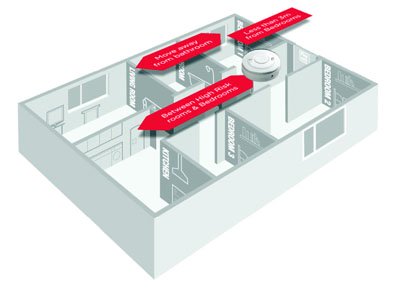
- Where there is heavy traffic – a smoke alarm MUST be installed in the most frequently used room such as the living room or lounge area.
- Circulation spaces – an alarm MUST be installed in areas that people use for movement between rooms on each storey of the home such as hallways and landings.
- SELECT recommends that an alarm is installed within 3m from every bedroom door so that the alert can be heard from within.
- All cooking areas MUST have an alarm installed.
- Avoid fitting alarms in bathrooms or directly outside them as steam and moisture can trigger the alarm causing false panic.
- Alarms should be positioned 300mm away from walls, light fittings or any other obstructions.
- All alarms should be fixed to the ceiling and interlinked to ensure if one alarm is triggered they will all be activated.
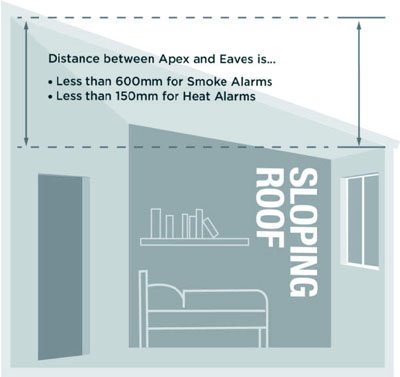
- On stairways, fire alarms should be positioned at the top and bottom of the stairs – not on the sloped roof.
- On peaked and sloped ceilings, smoke alarms should be fitted 600mm vertically down from the apex. Heat alarms should be positioned 150mm vertically down from the apex.
- In a room where there is a boom, this will affected the positioning of the alarm – see below.



Carbon Monoxide - What is it?
Carbon monoxide (CO) is a posionious gas that can be fatal if exposed to. It has no colour, taste and is odourless making it even more deadly. Signs of low level exposure include headaches and nausea. High level exposure can cause death.
CO sources within your home can be caused by any fuel-burning appliances such as a boiler, gas fire, gas cooker, wood-burning stove, clothes dryers and water heaters.
Due to the invisible nature of CO, it is impossible for humans to tell if it is present, therefore the only way to protect you and your family is to install an effective carbon monoxide detector. The new fire safety regulations apply to CO alarms.
Carbon monoxide detectors should be fitted in all rooms where there is a fixed fuel-burning appliance or a flue. Depending on where you’re installing it, there are different requirements.
- Alarms should be fitted on the ceiling, 1m-3m from potential CO sources, and at least 300mm from any obstructions.
- In a confined space, e.g. a boiler room, fit the alarm on the ceiling just outside.
- Alarms should always be fitted at breathing height.
- If installed in a bedroom, this could be the height of the bedhead.
What is the Tolerable Standard?
The Tolteable Stanard is the minimum requirement all homes and properties must meet when fitting the smoke, heat and CO alarms mentioned within the new regulations.
If you do not carry out the work as mentioned within the new regulations your property will not meet the Tolterable Stanadards and therefore be treated as not being in a reasonable state of repair. Local authorities can take action against you to ensure you take action to mame sure your property is compliant with the law.

What is the Repairing Standard?
The Repairing Standard applies solely to private landlords in Scotland. This is the minimum requirement that must be met by a rented proerty at the start of any tenancy and which must continue throughout the occupancy.
Landlord must fit the equipment as outlined in the new fire regulations 2022 and ensure these devices are either mains-powered alarms or tamper-proof long-life lithium battery alarms.
In the case of a house of multiple occupation (HMO), a more stringent standard is required under the terms of your licence.
More details of this and the Tolerable Standard are available on the Scottish Government website.
Where can I get more details?
Graham Robertson Electrical & Security are working in partnership with SELECT to provide information on the new regulations coming into force on 1st February 2022. Get in touch with us to discuss any questions you may have about getting your property ready ahead of February 2022.
Further information can also be found on the Scottish Government website.
For more information about Fire and Smoke Alarms Regulations in Scotland call us on 01786 468 050, email us or use our enquiry form.